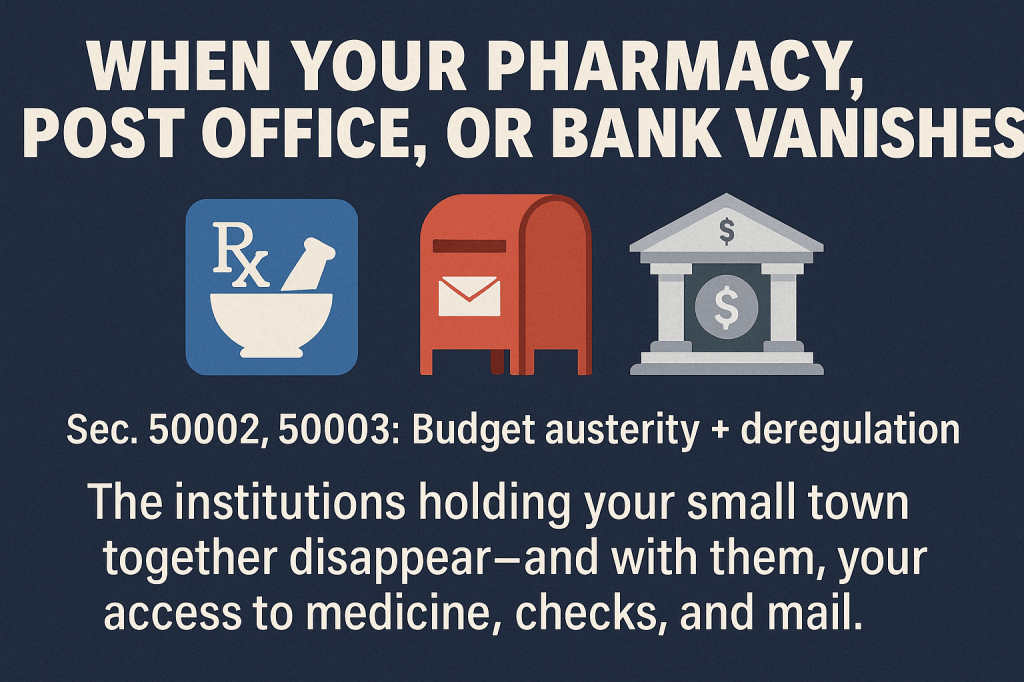
Bold claims about the Big Beautiful Bill are everywhere. This is another claim circulating on social media. Whether these statements are correct, exaggerated, or emotional venting, they offer something valuable: a spark. A reason to dig deeper. We need to examine them one-by-one. Only then can we build a clearer understanding of what’s really in this sweeping piece of legislation.
🧩 The Claim
“WHEN YOUR PHARMACY, POST OFFICE, OR BANK VANISHES
Budget austerity + deregulation (Sec. 50002, 50003)
The institutions holding your small town together disappear—and with them, your access to medicine, checks, and mail.”
📜 What the Bill Says
- Sec. 50002: Caps federal discretionary spending growth to 1% annually for 10 years. This includes agencies like the FDA, USPS, and financial regulators.
- Sec. 50003: Introduces a regulatory freeze: for every new federal rule, two must be repealed, with strict cost-benefit thresholds.
🧠 Key Insight
This blanket austerity typically reduces workforce, cuts service hours, and shrinks physical infrastructure—especially in low-population regions.
But here’s the real question:
What if advanced technology—AI systems, autonomous vehicles, drones, and digital infrastructure—preserve or even improve service, at lower cost?
Let’s unpack that.
🧬 Enter the Tech Stack: AI, Drones, and Digital Agents
| Agency/Service | Current Risk Under Bill | AI/Automation Offset? |
|---|---|---|
| FDA (Drugs & Devices) | Budget caps may reduce staff, delay approvals | LLMs can assist in regulatory review, flag anomalies, speed up approval cycles |
| USPS (Mail Delivery) | Declining visits, shrinking budgets, service cuts in rural areas | Drones/autonomous trucks for last-mile delivery, AI for route optimization |
| Banking (Community/Regulatory) | Deregulation may weaken oversight or rural protections | AI agents to detect fraud, assist consumers, automate compliance workflows |
🚀 Example Applications:
- AI copilots for compliance reviewers could process thousands of pages per second—cutting labor costs while improving consistency.
- Rural post delivery by drone or electric AVs could extend reach even after physical offices close.
- AI-powered chat agents can replace some low-level financial services while maintaining availability 24/7—even in small towns.
🔬 Real Numbers for Context
🏥 FDA
- ~21,000 employees
- ~$7.2B budget
- AI could automate literature review, data triage, and early-stage clinical screening, reducing manual overhead.
📬 USPS
- 28% decline in retail visits over the last decade
- $9.5B net loss in 2024
- Still delivers to 166M addresses—a network ripe for automation, not just downsizing.
🏦 Banking
- Smaller banks often rely on federal compliance aid. With fewer regulators, AI might fill the gap via automated audits or fraud detection.
🧭 Final Take: The Truth Lies in the Tension
Yes, this bill imposes tight constraints—and agencies will feel pressure. But that’s only half the story.
The other half is this:
If we aggressively deploy AI, autonomous tech, and digital infrastructure with intention, the U.S. will actually increase access, reliability, and speed—even while cutting costs.
But let’s be clear—this shift doesn’t happen automatically. It demands investment, regulatory flexibility, and responsible innovation. AI and drones will scale, but they do not replace human empathy. They do not replace local knowledge or trust in institutions—at least not yet.
👂 So what do you think?
Is it possible that AI and automation carry the weight where budgets drop? Or does deregulation risk leaving rural communities behind?
Drop what you’re hearing—good, bad, or weird. We’ll vet and break it down here.

 Is A Bill Just A Bill?
Leave a comment