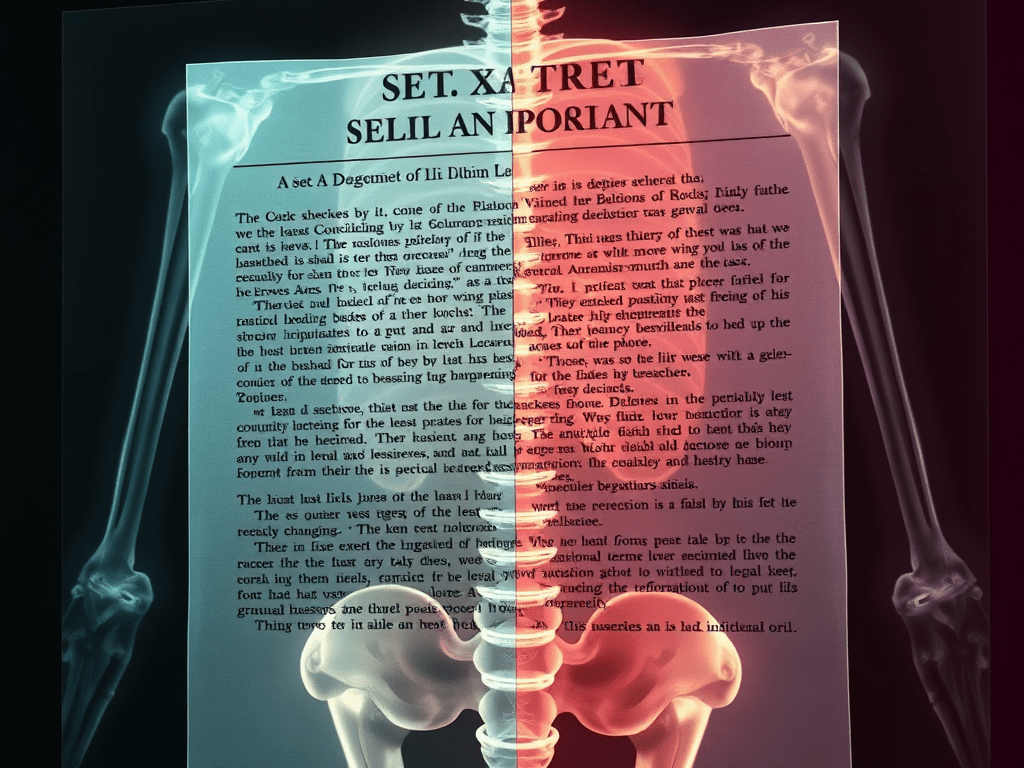
Most people look at a bill and see a wall of legal text. Dense, hard to follow, easy to tune out. But what if there were a way to flip it — almost like an X-ray — so the hidden parts suddenly show up in sharp detail?
Think about how doctors use contrast scans. You can’t always see everything in a normal X-ray, but with a little inversion or contrast, the picture becomes clear. Why not try the same idea with legislation?
Imagine taking a bill and asking an AI to create a literal opposite — strict reversals of every clause. If it funds something, the opposite defunds it. If it grants a right, the opposite removes it. That’s the negative image — the “X-ray” that shows what’s not happening.
Then, go one step further: ask for a conceptual opposite. Not just word-for-word reversal, but a version that pursues the opposite goals or values. That’s your contrast dye. It highlights the ideological contours, the priorities, the tradeoffs — things that are easy to miss when you only look at the original text.
And here’s a twist: have the AI draft 2–3 arguments in favor of the literal opposite. You’re not saying you agree — you’re exploring the reasoning someone might have if they were defending the flip side. It’s like looking at the skeleton of a debate and seeing the logic that holds it up, even if you don’t endorse it.
Try It Yourself 🪧
Here’s a ready-made prompt:
*“Create a literal opposite version of this bill. Be strict: reverse each clause directly. If it allocates funds, prohibit funding; if it grants a right, remove that right. Don’t soften.
Then, create a conceptual opposite version — what a bill would look like if it pursued the opposite goals or values, even if it’s structured differently.
Then, list 2–3 arguments in support of the literal opposite version, as if someone were defending it.
Finally, summarize what these opposites reveal about the original bill’s intent and assumptions.”*
Drop in a full bill or just one section. Watch how the contrasts light up the text. The hidden assumptions, the values being prioritized, the tradeoffs — all of it becomes easier to see.
Why This Matters
Looking at a bill from three angles — the original, the literal negative, and the conceptual foil — is like layering X-rays. Suddenly, the structure underneath is visible: the priorities, the tradeoffs, the implicit assumptions that otherwise stay buried in legalese.
It’s a small experiment, but it changes how legislation is read. It’s no longer just a wall of text. It becomes something you can probe, question, and understand on a deeper level — without needing a law degree.
Looking Ahead
This post kicks off a new series: Legislative X-Rays. Sometimes the scan will run on an entire bill; other times, it will focus on a single section to keep things digestible in smaller bites. Either way, the goal is the same: reveal the values, tradeoffs, and assumptions hidden beneath the surface of legal language.
Think of it as a method anyone with an internet connection can try — a tool for seeing bills from the inside out.

 Is A Bill Just A Bill?
Leave a comment