Recent developments at the federal level, combined with a forward-thinking approach, suggest a powerful possibility.
The Federal Green Light: Blockchain Beyond Bitcoin
You might have recently heard whispers about the U.S. Department of Commerce launching a project to publish official economic data, including GDP, on public blockchains. Yes, blockchain – the technology often associated with cryptocurrencies.
Why is this a big deal? Because it signals a quiet but profound shift: the federal government is embracing blockchain for a critical purpose – data integrity and immutability. They’re not trading Bitcoin; they’re using blockchain to create an unchangeable, verifiable record of vital information. This isn’t just tech-speak; it’s a powerful endorsement that opens the door for states to explore similar secure applications.
The Problem with “Online Voting” (and Our Smart Solution)
Let’s be clear: a truly secure, remote “online voting” system, where you vote from your personal laptop, remains a security minefield. The biggest vulnerability isn’t the government’s system; it’s your device, which can be easily compromised. Estonia, a pioneer in e-governance, has faced significant criticism on this front, despite their impressive digital society.
Our proposed solution strips out that dangerous “online” component. Instead, we focus on making the in-person voting experience more robust, more secure, and less prone to human error, all while preserving the crucial paper trail.
Introducing the Hybrid Digital Voter ID: A Win-Win-Win
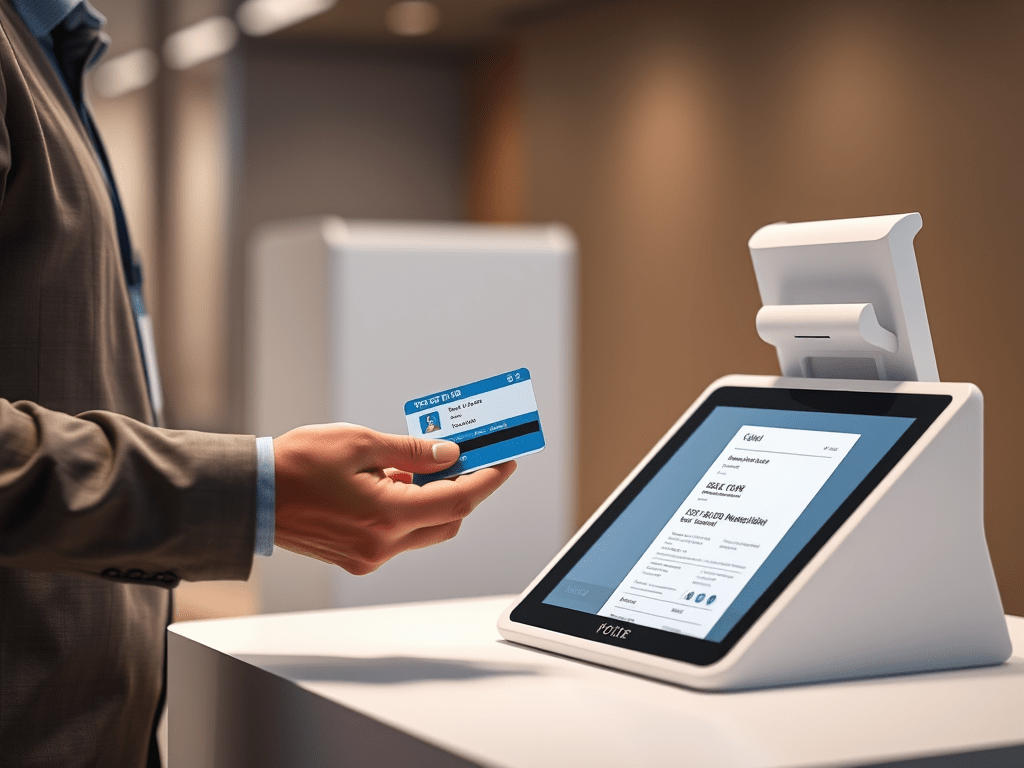
Imagine this: Your voter registration card is no longer just a piece of paper. It’s a secure smart card, much like your driver’s license or a bank card. It contains your encrypted digital identity, potentially even biometric data like your fingerprint.
When you arrive at your polling place:
- Swift, Secure Verification: You present your smart card. A poll worker uses a dedicated, secure device to instantly verify your identity and your registration status, potentially with a quick fingerprint scan. This eliminates manual lookups, reduces lines, and virtually eradicates identity fraud.
- Effortless Digital Ballot: Once verified, you move to a private, user-friendly digital voting machine (like a secure tablet). No more struggling with paper forms or confusing instructions. You make your selections with ease.
- The Unbreakable Paper Trail: Here’s the critical part: after you confirm your choices, the machine prints a paper ballot summarizing your selections. You visually confirm it’s exactly what you intended.
- Instant, Auditable Count: You then feed this confirmed paper ballot into a separate, secure optical scanner. This physical ballot becomes the official record, allowing for recounts and audits, while its digital scan provides an instant, accurate tally.
What’s in it for YOU, the Voter?
- Faster Lines: Quicker check-ins mean less waiting.
- Error-Free Ballots: The digital interface guides you, preventing common mistakes like over-voting or undervoting.
- Rock-Solid Trust: You get a physical receipt (your paper ballot) that you’ve reviewed and verified, ensuring your vote is counted as cast.
- Enhanced Security: Digital identity verification and blockchain-backed integrity make voter fraud virtually impossible.
What’s in it for Legislators and Election Officials?
- Increased Efficiency: Streamlined operations, reduced training for poll workers, and faster election night reporting.
- Unquestionable Integrity: A system designed for maximum security, auditability, and transparency, restoring public confidence in election outcomes.
- Reduced Costs Over Time: While initial investment is needed, the reduction in manual errors, dispute resolution, and potentially even printing costs for blank ballots could lead to long-term savings.
- Future-Proofing Elections: Building a modern, adaptable infrastructure that can evolve with technology.
Tackling Key Challenges: Vote Harvesting and Accessibility
This hybrid digital ID approach directly addresses some of the most persistent challenges in election integrity:
- The End of Vote Harvesting Concerns: The primary method for vote harvesting involves collecting and potentially altering mail-in ballots outside of a supervised polling place. Our system is designed for secure, in-person voting. By requiring voters to physically authenticate with their digital ID and cast their vote in a controlled environment, it significantly diminishes the opportunities for such activities. While mail-in voting would still exist, this secure in-person backbone would provide a strong deterrent against manipulation.
- Empowering Mobile Polling Stations for True Accessibility: Imagine bringing the full security of a polling place directly to those who need it most. With this technology, mobile teams equipped with a portable smart card reader and a ballot printer/scanner could deploy to:
- Nursing Homes: Ensuring residents can cast their vote securely, without the risks associated with unsupervised absentee ballot collection.
- Hospitals: Allowing patients to participate in democracy even when confined.
- Remote Communities: Providing secure voting access where traditional polling places are sparse. This transforms a cumbersome process into an efficient, secure, and accessible on-demand voting solution.
The Ultimate Transparency: Smart Glasses and Body Cameras for Chain of Custody
For an unprecedented layer of accountability, this concept can integrate advanced documentation:
- Visible Verification: Authorized election personnel, from those collecting ballots from secure drop boxes (where permitted) to those transporting them to tabulation centers, could wear smart glasses or body cameras, much like law enforcement.
- Irrefutable Record: These devices would continuously record the entire chain of custody for physical ballots and sensitive equipment. Every transfer, every movement, every secure seal would be visibly documented.
- Blockchain-Anchored Video: The video footage itself could be timestamped and cryptographically linked to a blockchain, creating an immutable, verifiable record that confirms the integrity of the process. If a question ever arises about a ballot’s journey, the video evidence, backed by blockchain’s trust, would provide an objective, irrefutable answer. This adds an unparalleled level of transparency and deterrence against tampering.
The “Enterprising State” Advantage: Leading the Way
Implementing such a system requires foresight and, yes, financial resources. This is where states running a budget surplus become prime candidates. These “enterprising states” have the financial flexibility to:
- Fund Pilot Programs: Test the system in a controlled environment (e.g., a single county) to refine it before a statewide rollout.
- Invest in Expertise: Attract and hire top cybersecurity and blockchain talent.
- Demonstrate Leadership: Position themselves as innovators in democratic governance.
Consider a state like Texas or Florida that has recently reported a strong budget. Such a state is perfectly positioned to lead.
Let’s Talk Numbers: What Would This Cost a County?
Cost estimates for a pilot program vary widely based on scale and existing infrastructure, but we can provide a rough model for a medium-sized county (e.g., 250,000 registered voters).
Estimated Costs for a Pilot Program in a Medium-Sized County:
- Digital ID Card Issuance: Assuming a rollout over several years, tied to driver’s license renewals or specific registration drives.
- Smart Card Production & Personalization: $5-$10 per card.
- Total (initial batch for ~25% of voters in a pilot): $312,500 – $625,000 (for ~62,500 voters).
- (Note: This is a significant investment but can be amortized over time and integrated with existing state ID systems.)
- Polling Place & Mobile Hardware/Software (for ~100 polling places and ~5 mobile units):
- Secure ID Card Readers with Biometrics: $1,000 – $2,500 per unit (2-3 per polling place + 1-2 per mobile unit).
- Digital Ballot Printing & Scanning Units: $5,000 – $10,000 per unit (1-2 per polling place + 1 per mobile unit).
- Secure Network Infrastructure (for data transmission, not remote voting): $500 – $1,500 per polling place/mobile unit.
- Specialized Ballot Design & Management Software: $50,000 – $200,000 (county-wide license).
- Total Hardware/Software: $1.2 Million – $2.8 Million.
- Cybersecurity & Blockchain Integration:
- Blockchain Layer for Data Integrity (hashing voter records & video logs): $150,000 – $400,000 (initial setup, ongoing maintenance relatively low).
- Security Audits, Penetration Testing: $50,000 – $150,000.
- Total Security: $200,000 – $550,000.
- Documentation & Transparency Hardware:
- Body Cameras/Smart Glasses (for key personnel): $500 – $1,500 per unit (e.g., 50 units).
- Video Storage & Management System: $25,000 – $75,000.
- Total Transparency Hardware: $50,000 – $150,000.
- Training & Rollout Support:
- Poll Worker Training, Public Education Campaigns: $100,000 – $300,000.
Estimated Total for a Medium-Sized County Pilot: $1.9 Million – $4.425 Million
(These are rough estimates. Actual costs would depend on vendor contracts, existing infrastructure, and specific features. Federal grants or state funding could significantly offset county costs.)
This is not a proposal for a radical overhaul overnight, but a strategic evolution. By learning from both the successes and challenges of digital governance globally, and by leveraging the trust-building potential of blockchain for data integrity and video evidence, we can build a voting system that is not only robustly secure but also genuinely serves the needs of every voter and restores public confidence. Which state will step up to lead this vital democratic innovation?

 Is A Bill Just A Bill?
Leave a comment