Let’s sit with this follow-up. The previous piece laid out what veteran 4th-grade teachers see year after year: kids arriving without solid 3rd-grade foundations — avoidance during independent reading, fluency that fractures on multi-syllabic words, working memory consumed by decoding, and the slow erosion of confidence once “reading to learn” begins in earnest. Those patterns concentrate with frustrating consistency in the same districts and neighborhoods.This isn’t new. Massachusetts has tracked 3rd- and 4th-grade reading for decades via MCAS and the national NAEP benchmark. Statewide averages show a slow pre-pandemic slide that worsened, with recent 3rd-grade ELA results still lagging pre-2020 levels. The deeper story is the stubborn floor that has barely budged for 15–20 years in specific communities.
Where the Floor Has Held
In Gateway Cities and high-needs urban areas, 3rd-grade proficiency has long hovered in the mid-teens to low-30s percent range across testing cycles. These are the exact schools sending cohorts into 4th grade where teachers immediately recognize the incoming gaps.
- Holyoke, Lawrence, and Springfield have anchored the bottom for a generation. They feature high concentrations of low-income students (often 80–90%+), large English Learner populations, elevated special education needs, and student mobility. State receiverships were direct responses to this chronic stagnation. Gains under intervention have been modest.
- Inside Boston Public Schools, the divide repeats at neighborhood scale. Roxbury and Mattapan neighborhood schools have historically posted some of the lowest results, often 15–25%. Dorchester shows sharp variance — traditional high-need pockets track low while certain structured programs serving the same kids perform better. Jamaica Plain reflects gentrification: resource-rich blocks alongside public housing areas with heavier loads.
Kids in these buildings are bright and capable. What they frequently lack is systematic, brain-aligned early decoding and language structure. When basic word recognition eats working memory, inference, content knowledge, and writing all suffer.
What Actually Works — and How Fast Teachers Can Get There
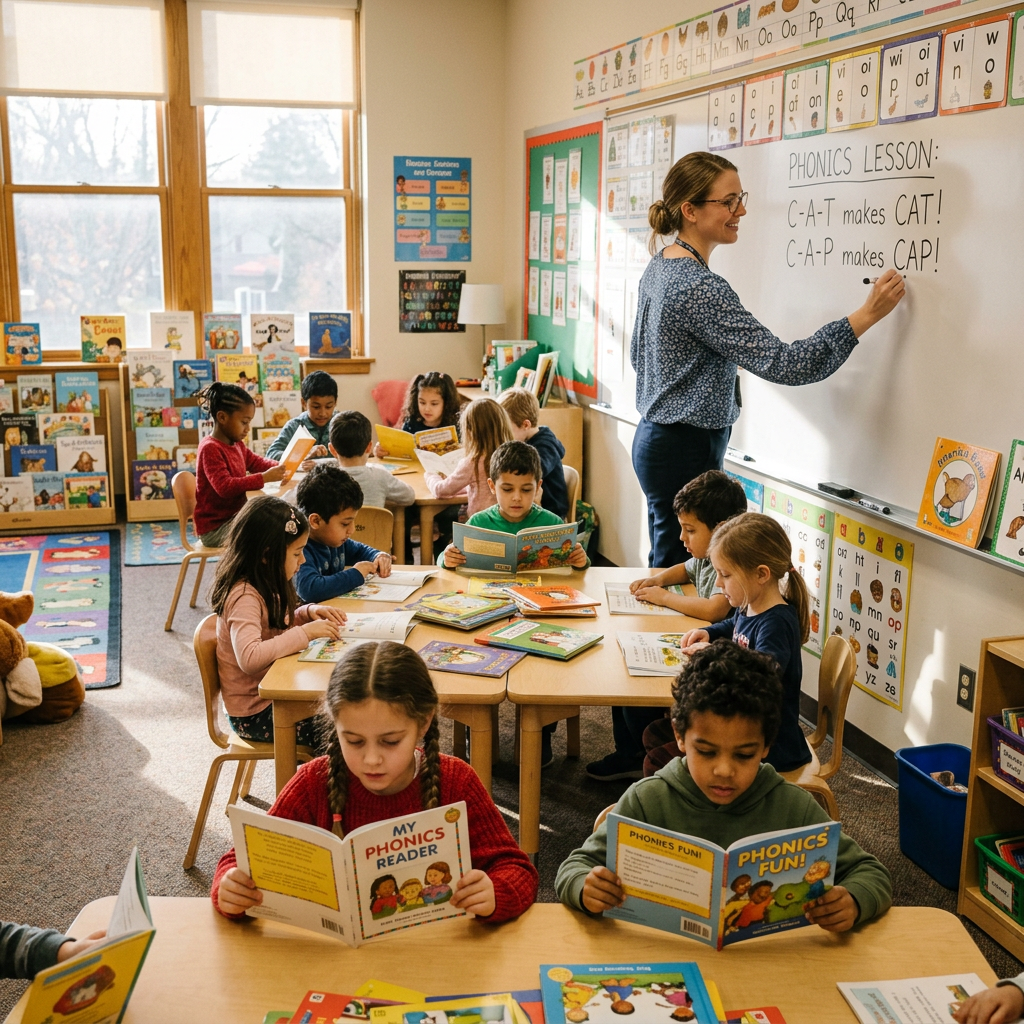
Effective approaches share core traits: explicit phonemic awareness, phonics-first (sounds before letter names), writing/encoding before full reading, and multi-sensory practice. Montessori methods demonstrate this powerfully — teaching sandpaper letters (sound + trace), moveable alphabets for building words, then progressing through color-coded series (pink CVC words, blue blends, green phonograms). Children often experience a spontaneous “explosion into reading” around ages 4.5–5.5 after 2–3 years of self-paced work starting at age 3.Charter and structured public schools achieve similar results at scale through Systematic Synthetic Phonics programs (e.g., Wilson Fundations, Heggerty, Amplify CKLA). These use scripted routines, hand cues, tapping, and tight 10–30 minute daily phonics blocks inside a broader 90–120 minute literacy block. Sessions stay short and high-energy to match young attention spans, with small-group decodable reading and knowledge-building read-alouds.Crucially, teachers don’t need years of philosophical overhaul to deliver results. Highly engineered curricula let organized adults get operational in 1–3 days of bootcamp plus ongoing coaching. Coaches provide real-time fidelity checks — spotting muddy sounds, pacing issues, or script drift. Montessori relies on rigorous “Albums,” three-period lessons, and built-in material controls. Both paths show rapid, effective implementation is possible when structure and support align.
The Bill on the Governor’s Desk
Legislation moving forward (including the Early Literacy Fund) rightly pushes evidence-based instruction for K–3. Yet it raises practical questions for the communities carrying the heaviest load. The $25 million allocation for professional development and implementation lacks clear itemization — how exactly was this figure reached, and how will it break down across training, materials, and coaching in the highest-needs districts?More critically, details on teacher training remain thin. How precisely will educators — especially in chronically lower-performing schools — be brought up to speed on phonics-first delivery without multi-year delays? Proven models show it’s possible to equip teachers quickly with strong scripts, short daily routines, and consistent coaching. Without tighter specifics, the risk is another layer of policy that sounds right on paper but moves too slowly where the floor has been lowest for decades.Literacy is the operating system. In the places with the steepest structural challenges, getting foundations right early determines whether doors open or close quietly.Parents and activists across Massachusetts should contact members of the Senate Ways and Means Committee and the Governor’s office now. Urge them not to sign the bill in its current form. Demand it be reworked with a clear, anti-fragile framework: specific, itemized plans for training, implementation timelines, accountability metrics, and targeted support for the districts and neighborhoods that have lagged longest.
Senate Ways and Means Committee Members to Contact:Democratic Members (Chair):
- Michael J. Rodrigues (Chair)
- Joanne M. Comerford (Vice Chair)
- Paul R. Feeney (Assistant Vice Chair)
- Michael D. Brady, Nick Collins, Brendan P. Crighton, John J. Cronin, Lydia Edwards, Adam Gómez, Robyn K. Kennedy, Paul W. Mark, Liz Miranda, Jacob R. Oliveira, Pavel M. Payano, Michael F. Rush
Republican Members:
- Patrick M. O’Connor (Ranking Minority)
- Ryan C. Fattman
- Kelly A. Dooner
This is the moment to insist on details that match the urgency of the crisis. The kids in these schools can’t wait for another vague rollout. Let’s push for implementation that actually works where it’s needed most.





Leave a Reply